If you can fill the unforgiving minute With sixty seconds' worth of distance run - Yours is the Earth and everything that's in it, And - which is more - you'll be a Man my son! Death and legacy Died on 18 January 1936 of a perforated duodenal ulcer Buried in Poets' Corner A crater on the planet Mercury would be named after Kipling A swastika printed on covers associated with a picture of an elephant carrying a lotus flower 1935 warning of the danger Nazi Germany Bibliography The Story of the Gadsbys (1888) "Recessional"(1897) Plain Tales from the Hills (1888) The Day's Work (1898) The Phantom Rickshaw and other
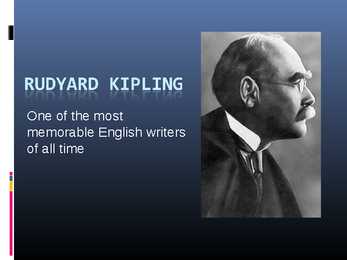
Among other honours, he was sounded out for the British Poet Laureateship and on several occasions for a knighthood, all of which he declined. Later in life Kipling came to be recognized as a "prophet of British imperialism." Many saw prejudice and militarism in his works, and the resulting controversy about him continued for much of the 20th century. Kipling kept writing until the early 1930s, but at a slower pace and with much less success than before. He died of perforated duodenal ulcer on 18 January 1936, two days before George V, at the age of 70. His death had in fact previously been incorrectly announced in a magazine, to which he wrote, "I've just read that I am dead. Don't forget to delete me from your list of subscribers." Rudyard Kipling was cremated at Golders Green Crematorium and his ashes were buried in Poets' Corner, part of the South Transept of Westminster Abbey, where many distinguished literary people are buried or commemorated.
the monarch, since the time of Charles II )Some claim that he was offered the post during the interregnum of 1892-96 and turned it down. At the beginning of World War I, like many other writers, Kipling wrote pamphlets which enthusiastically supported the UK's war aims. Death and legacy Kipling kept writing until the early 1930s, but at a slower pace and with much less success than before. He died of a perforated duodenal ulcer ( perforeeritud kaksteistsõrmiksoole haavand ) on 18 January 1936, two days before George V, at the age of 70. His death had in fact previously been incorrectly announced in a magazine, to which he wrote, "I've just read that I am dead. Don't forget to delete me from your list of subscribers. Rudyard Kipling was cremated and his ashes were buried in Poets' Corner, part of the South Transept of Westminster Abbey.
 annaabi.ee