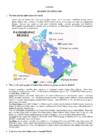
Hudson Bay. It is rugged, stony and with thin soil. Southeast of the Shield is the Valley of the St. Lawrence River which embraces the parts of Quebec and Ontario that lie along that river and Lakes Ontario and Eire. West of the Shield, we find two vertical bands of land that run from the Arctic southward into the US. This is called the Interior Plains Region. Next, the most westerly area is nearly all mountain, running from north to south along the Pacific coast. This is called the Cordilleran Region after the system of mountains which dominates the entire west coast of North America. The St. Lawrence river and the Great Lakes form the greatest fresh-water highway in the world, a natural thoroughfare 2500 miles long leading from the Atlantic Ocean westward into the heart of the continent.
CANADA REVISION QUESTIONS 2010 1. The main physiographic regions of Canada. Canada may be divided into seven physiographic regions: Arctic Lowlands, Cordilleran Region, Interior Plains, Hudson Bay Lowlands, Canadian Shield (Forest Lands), St Lawrence Lowlands and Appalachian Region. Divisions are based on each area's relatively similar physical geography and landforms. Physiographic regionalization is defined here as the process by which regions with relatively homogeneous physical geography are determined 2. Who are the native people of Canada? Into which three groups can they be divided?
 annaabi.ee