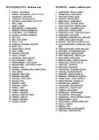
HEITLEHISED PUUD - Deciduous trees OKASPUUD Conifers, coniferous trees 1. arukask - silver birch 1. harilik kuusk Norway spruce 2. sookask downy birch, pubescent birch 2. kanada kuusk white spruce 3. maarjakask curly birch 3. must kuusk black spruce 4. tundrakask mountain birch 4. idakuusk oriental spruce 5. vaevakask Arctic birch, dwarf birch 5. ajaani kuusk Yeddo spruce 6. haab aspen 6
Alligators can also be found there. Bison (buffalo) exists now only in protected areas. In the western areas live elk, deer, bighorn sheep, mountain goats and a small number of brown bears. The Kodiak bear, the largest carnivore found in North America, is found in Alaska. Plants The vegetation of Northern Alaska consists of lichens, mosses, low shrubs and flowering plants. In the southern part of Alaska grow conifers, spruces and firs. Around the Great Lakes and New England are mixed forests of pines, maples, elms, birches, oaks etc. Along the Gulf of Mexico grow magnolia, red and black gum, cypress and mangrove. In the west grow forests of sequoia. In the NW grow conifers firs, hemlocks, cedars, spruces and pines. Agriculture Agriculture is a major industry in the United States and the country is a net exporter of food.
As a result the RHS lays down very careful judging criteria to ensure fair play and to disarm the critics. These are clearly set out in the Show's annual catalogue and exhibitors' manual. Most awards at Chelsea are made to exhibits that are groups of different plants, flower, fruit, or vegetables. An exhibit can be made up of one plant type alone, from roses to potatoes, in this many garden varieties, or might comprise different plant types, such as conifers or cacti. Alternatively the exhibit might concentrate or special growing techniques, such as bonsai. Other classes take in outdoor exhibits of plants in display and courtyard gardens, or those in display gardens inside the Floral Marquees. A Gold medal is highest one, and it has no qualifications attached, nor is there any limit to the number awarded. If the judges decide you deserve Gold, you will be given one. There is enormous variation in the interest created by the awards
– Finnish Peatland Society. Nr 3, lk 101-113. 25. Pihelgas, E. (1983). Metsa bioloogia. Tallinn: Valgus. lk 224. 26. Pleijel, H. (1993). Ökoloogiaraamat. Tallinn: Tallinna Raamatutrükikoda, lk 95. 27. Pärn, H. (2008). Männipuistute radiaalkasvust muutuvates keskkonnatingimustes. – Forestry studies (Metsanduslikud uurimused). Nr. 48, lk 41-52. 28. Pärn, H., Mandre, M. (2011). Dendrochronological analysis of the growth and growth–climate relationships of conifers in the region of alkaline dust deposition. – Forest ecology and management. Nr 262, lk 88-94. 62 29. Rauk, J., Ots, K., Tuulemets, L. (1998). Okaspuude juurdekasvu sõltuvus kasvukeskkonna parameetritest Kunda tsemenditehase mõjupiirkonnas. – Metsanduslikud uurimused XXIX. Nr 29, lk 71-72. 30. Saarman. E, Veibri. U. (2006). Puiduteadus. Tartu: Vali Press OÜ, lk 560. 31. Suuroja, K., Mardim, T., Ploom, K., All, T
g. similar quantities of timber can be harvested year on year 2 grants for planting forests / management schemes; 3 planting to ensure sustainable harvest rate; max 3 marks for planting strategy: 4 trees not planted too closely together; 5 support young trees to prevent damage e.g. from grazing animals; 6 species planted that are suitable for prevailing conditions / native spp; 7 softwood sp. / conifers / named conifer / fast growing sp. planted; 8 deciduous broadleaved species around edges for aesthetic reasons; 9 creates different habitats / named habitat / protected habitats/ some fallen trees left to rot; max 3 marks for felling/cropping strategy: 10 ref. to clear felling having negative effects e.g. soil erosion; 11 only mature trees removed / selective felling / individual trees;
 annaabi.ee