1959 St. Lawrence Seaway (major transportation route) officially opens 1960 Québec's Quiet Revolution begins; Native Canadians given the vote 1967 Canada's 100th birthday; Expo 67 World's Fair in Montréal 1970 October Crisis: political kidnappings, Ottawa suspends civil rights 1980 Québec referendum on "sovereignty-association" defeated 60% to 40% 1982 Constitution comes home -- with a Charter of Rights and Freedoms 198790 Meech Lake Accord is put forward -- and collapses 1992 Charlottetown Accord is rejected by a national referendum 1995 Québec referendum on sovereignty is narrowly defeated 1999 The new Arctic territory of Nunavut is created 2000 Clarity Bill outlines the terms of Québec separation 2003 Canada says "no" to joining the war in Iraq 2005 Former PM Jean Chrétien and sitting PM Paul Martin testify at the Gomery Inquiry 2010 Canada sets record for gold medals at the Vancouver Winter Olympic Games
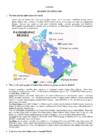
The monarchy is represented by the leutenantgovernor. The Frenchspeaking province of Canada (Quebec) is very different culturally. Since the 1960s there has been a strong movement to became an independent country (separatist movement). 80 % of Canada's French speaking people lives in Quebec. Canada has ten provinces and two territories (the capital of each is shown in parentheses): Alberta (Edmonton), British Columbia (Victoria), Prince Edwars Island (Charlottetown), Manitoba (Winnipeg), New Brunswick (Fredericton), Nova Scotia (Halifax), Nunavut (Iqaluit), Ontario (Toronto), Quebec (Quebec City), Saskatchewan (Regina), Newfoundland and Labrador (St. John's), Northwest Territories (Yellowknife) and Yukon Territory (Whitehorse). Geographically, Canada can be divided into five major regions: the Pacific Region, the Prairie Provinces, Central Canada, the Atlantic Provinces and the North. The Pacific Region includes Canada's westernmost
Language immersion - a method of teaching a second language in which the learners'are taught school subjects (e.g. math, social studies, science) in their second language. Distinct society - is a political term especially used during constitutional debate in Canada, in the second half of the 1980s and in the early 1990s, and present in the two failed constitutional amendments, the Meech Lake Accord and the Charlottetown Accord. "Distinct society" refers to the uniqueness of the province of Quebec within Canada, although here the meaning of "unique" is vague and controversial. 18. The status of the French language in Canada as a whole and in Quebec in particular. In what language are the immigrants to Quebec required to educate their children? The economic power was largely in the hands of the English. The French language did not enjoy the same status
 annaabi.ee