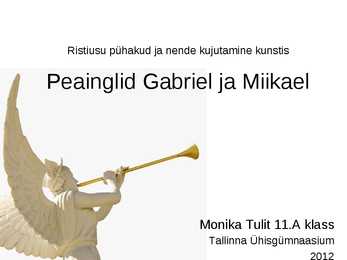
Anthony Kaldellis, Hellenism in Byzantium. The transformation of Greek identity and the reception of the classical tradition. Cambridge: Cambridge University Press, 2007. Lugemismaterjali antiigipärandi 1. loengu juurde: lk 173187 (pdf-fail olemas ÕISis, kodutoo1_Kaldellis_tekst.pdf) Küsimused: 1) Kuidas suhestusid katkendis kirjeldatud perioodil kristlus ja antiik üksikute autorite kontekstis? Too näiteid. Umbes kuuendal sajandil hakkas antiigi pärand oma varjusurmast ärkama, kuid ei lisanud veel oma motiive kristlikku kultuuri, vaid eksisteeris paralleelsena. Näiteks kirjutas Nonnos Panopolisest poeemi Dionysosest Indias ning ka parafraasi Johannese evangeeliumist. Paralleelselt leidus nii paganlikke ja erootilisi kui ka kristlikke luuletusi. Viiendal kuni seitsmendal sajandil arenes välja kristliku klassitsismi zanr, milles leidus motiive antiigist. See lõpes pära...
htm http://www.slideshare.net/hommik/vanarooma-arhitektuur http://www.slideshare.net/Kunstiajalugu/7rooma-kunst http://www.bookdrum.com/books/the-interpretation-of-dreams/9780199537587/bookmarks-226-250.html http://maryellenb.typepad.com/o_night_divine/picture-study/ http://www.oceansbridge.com/oil-paintings/product/74280/thearchangelmichaeldefeatingsatan http://www.royalacademy.org.uk/exhibitions/byzantium/image-gallery-exhibition-highlights/gallery-of-key- images-7,16,BZ.html
They however fell apart rapidly in the second half of the 12th century giving rise to various semiautonomous Turkic dynasties. In the 13th and 14th centuries the Ottoman empire (named after Osman I) emerged from among these "Ghazi emirates" and established itself after a string of conquests that included the Balkans, parts of Greece, and western Anatolia. In 1453 under Mehmed II the Ottomans laid siege to Constantinople, the capital of Byzantium. The Byzantine fortress succumbed shortly thereafter, having been battered by superior Ottoman cannonry. Beginning in the 13th century, Sufism underwent a transformation, largely as a result of the efforts of alGhazzali to legitimize and reorganize the movement. He developed the model of the Sufi order--a community of spiritual teachers and students. Also of importance to Sufism was the creation of the Masnavi, a collection of mystical poetry by the 13th century Persian poet Rumi
names like Chester, Lancaster and Gloucester which include variants of the Roman word castra (a military camp). 23 Notes 1. In the 1st с. BC – the 4th c. AD Rome founded the greatest ancient empire whose provinces extended from the Caucasus in the east and Egypt in the south to Spain and Gaul in the west and Britain in the north-west. In 395 the empire was divided into two parts – the Western (Rome) and the Eastern (Constantinople, Byzantium) empires. The former collapsed in the 5th century (476). Byzantium lasted for another thousand years and fell to the Turks in 1453. Gaius Julius Caesar ['si:zə] (100 – 44 BC), the Roman statesman, general and author. He conquered Gaul, Egypt, defeated his political opponents and became an absolute dictator (49 BC). Killed by Republican conspirators (M.J. Brutus and G. Cassius). His Commentaries on the Gallic War contain important information about the Celts
existed, and so the letter could not be mutilated. Sometimes this was done anyway, to destroy the suspected code. Technological steganography early in the war consisted almost exclusively of invisible inks. This is truly an ancient device. Pliny the Elder, in his Natural History, written in the first century A.D., told how the "milk" of the tithy-mallus plant could be used as a secret ink. Ovid referred to secret ink in his Art of Love. A Greek military scientist, Philo of Byzantium, described the use of a kind of ink made from gall nuts (gallotannic acid), which could be made visible by a solution of what is now called copper sulfate. Qalqashandi described several kinds of invisible ink in his Subh al-a' sha. Alberti mentions them. The Renaissance employed them in diplomatic correspondence. About 1530 a book was printed with panels in invisible ink; if these pages were dipped in water, the message would appear; this could be repeated three or four times.
 annaabi.ee