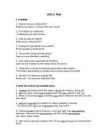
One of the old customs was called "creeling the bridgegroom", which meant that the bridgegroom had to carry a large basket filled with stones on his back around the town until (1) I of the house and kiss him. On the day of the wedding (2) F to lead the new couple to the church. The first wedding service was held just by the doors of the church. The priest (3) C. After that the priest (4) H where the ceremony took place once more in Latin. At the end of the ceremony the bride and bridegroom exchanged rings and kissed (5) D After the ceremony the wedding guests gathered (6) B for a wedding reception where the pipers played for hours. Traditionally, the first dance of the night was for the wedding couple, after which everyone could join in. When the reception was over, the couple went (7) G where the bridegroom, wishing to protect his bride from the evil spirits that lived in the floor at the entrance, carried the bride into her new home.
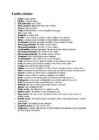
· Cousin: any child of one's uncle or aunt · Nephew: a son of one's brother or sister or of one's brother-in-law or sister-in-law · Niece: a daughter of one's brother or sister or of one's brother-in-law or sister-in-law · Fiancée: a woman to whom a man is engaged to be married · Fiance: a man to whom a woman is engaged to be married · Bride: a woman on her wedding day or just before and after the event · Bridegroom: a man on his wedding day or just before and after the event · Wife: the woman to whom a particular man is married · Husband: the man to whom a particular woman is married · Spouse: one's husband or wife · Father-in-law: the father of one's husband or wife · Mother-in-law: the mother of one's husband or wife · Sister-in-law: the sister of one's husband or wife or the wife of one's brother or brother-in-law
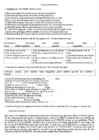
was created- rajati; wa named- nimetati Revision Sample answers 3) 1. Isi t Oki f I read your diary? 2. Isi t all right if I try your crash helmet? 3. Can I have some milk in my coffee? 4) Sample answers. 1. You might get hurt in an accident 2. You might fall into the water 3. You might burn yourself 4. You might get runover 5. You might get sunburned 6. They might get hurt or kiled on the road. U 15 WB 1. The bridge said she was going to wear her mother's dress at the w. 2. The bridegroom told his friend he wanted him to b ehis best man 3. The bridesmaids said they liked their dressed very much. 4. Lucy boyfriend said he'd wait for her after lessons. 5. The traffic warden told us parking wasn't allowed there . 6. The bank official told me I had to fill in that form, 7. The tourist asks me where the petrol station is. 2A) I'd like to know : Please tell me: 1. How tall are you 2. 2. Why you were absent yesterday 3. How you feel
Adult colleague nephew toddler best man fiancé niece twin bride neighbor sister-in-law widow a) The son of your brother or sister nephew g) The daughter of your brother or sister b) A woman on the day of her marriage h) A person who is fully grown c) A young child who is learning to walk i) A woman whose husband has died d) What a woman calls the man she is engaged to j) At a wedding, the friend of the bridegroom e) One of two children born at the same time k) The sister of the person you marry f) A person who lives near you 1) A person you work with 7. Complete each sentence with one suitable word. a) After a few days they realised they were in love. b) I went……. with a very interesting girl last week. c) Andrew acts as……. he was the most important person in the room. d) After two years, their marriage broke …….
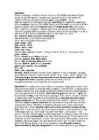
mainly oral, only selected poems written down by clerks at the command of noblemen/kings). Alliteration consonants at the beginning of words are repeated. Alliteration applied to stressed syllables. Alliteration bound together the two halves of the line. Therefore, the third stressed syllable (first in the second half) had to alliterate with at least one stressed syllable in the first half of the line. Old forms in general survive more easily in 1. compound words (BRIDEGROOM, WEREWOLF), 2. place names (SCARBOROUGH, CANTERBURY), 3. idiomatic phrases (e.g. OVER HILL AND DALE, HALE AND HEARTY), 4. rarely used archaic words with special meanings (e.g. WROUGHT IRON, where "wrought" is the old Past Participle form of "work")
a of horses One day a of coyotes tried to attack his animals. Farmer John yelled and waved a pitchfork to frighten them away. 36 Masculine and Feminine Nouns Masculine nouns are words for men and boys, and male animals. Feminine nouns are words for women and girls, and female animals. rooster bride bridegroom hen lion lioness Word File Masculine Feminine boy girl man woman prince princess steward stewardess
Will you come and see me?" "We shall often meet, I hope, in Hertfordshire." "I am not likely to leave Kent for some time. Promise me, therefore, to come to Hunsford." Elizabeth could not refuse, though she foresaw little pleasure in the visit. "My father and Maria are coming to me in March," added Charlotte, "and I hope you will consent to be of the party. Indeed, Eliza, you will be as welcome as either of them." The wedding took place; the bride and bridegroom set off for Kent from the church door, and everybody had as much to say, or to hear, on the subject as usual. Elizabeth soon heard from her friend; and their correspondence was as regular and frequent as it had ever been; that it should be equally unreserved was impossible. Elizabeth could never address her without feeling that all the comfort of intimacy was over, and though determined not to slacken as a correspondent, it was for the sake of what had been, rather than what was.
 annaabi.ee