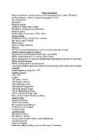
Indoeuroopa ülevaade MHG 10c Indo European Language Tree 10 Main Branches · Anatolian Languages Hittite · Hellenic Languages - Greek · Indo Iranian Languages- Hindu and Iranian · Italic Languages-Latin Romance Languages( Spanish, Italian, French) · Celtic Languages- Celtic (Rarely spoken now) · Germanic Languages- English and German · Armenian Languages- Armenian · Tocharian Languages- Extinct( Form of Greek) · Balto Slavic Languages- Slavic, Latvian, Lithuanian In Depth Look into Every Country with a Indo European Language
The goal 120 stories The reality 24 stories% Satirical and witty tales written in decasyllable lines Critical account on Chaucer's England Framework:pilgrims telling stories on their way to Canterbury The context and messages of the tales Corrupt clergy,general Distrust in the Church The criticism of chivalry violence The division of society Into three: 1)those who pray 2)those who fight 3.)those who work English language history Germanic Slavonic Romance Baltic Iranian Indic Greek Celtic Anatolian What did the Indo-Europeans bring ? · Male gods · War-centered worship and culture · Hierarchy · New languages · Herding introduced,later also agriculture Stages Old English (450-1100 AD) Middle English (1100-1500 AD) Early Modern English (1500-1800 AD) Late Modern English (1800- present day) Influences Latin monks and scholars from 7th century Old Norse Viking raids of late 8th century French After Norman conquest in 1066 Mongrel nation ? Old english
The most sought after is odd eyed white although blue eyed cats are also considered special while amber eyed whites are the least sought after. In Britain most matings are between an all-white cat and an auburn/white to produce a mix of all-white and auburn/white offspring (plus occasional cream/white offspring) with a mix of all three eye colours. Outside of Turkey, the Van Kedi may be recognised as a colour variant of Turkish Van rather than distinct breed. It is worth mentioning the Anatolian (Turkish Shorthair, Anadolu Kedisi) which is a naturally occurring cat similar in type to the Turkish Van with which it is allowed to breed. The Anatolian is found in all natural colours, with and without Van markings. In the past, many Anatolian cats were exported and registered as Vans or Angoras although Dutch and German breeders are striving for purebred Anatolians. The mistaken identity of Turkish Van suggests that they produce semi-longhaired variants.
 annaabi.ee