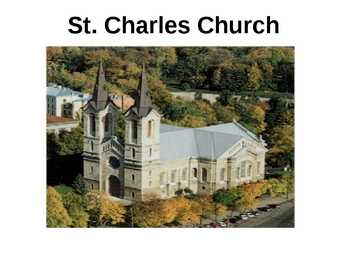
St. Charles Church Basic Information Built in pseudo-Romanesque style Architects: O.P.Hippius and R.von Bernhard Limestone church Built in 1862-1882 Area 1197 m2 Biggest church in Tallinn The Costruction of the Church The Altar Come to me- painted by Johann Köler It was ready in the 23 of juli in 1879 The bottom altarpieces are painted by Sally von Kügelgen in 1889 The Church Bells The North Tower The South Tower The Organ The first one was built in 1884 The second one was built in 1923 The biggest organ in Estonia
asteroid vaults dates from the 15th century. The Lady Chapel, built southwards from the chancel just before the Reformation in the early sixteenth century, is one of the most beautiful and noteworthy late-Gothic buildings in Estonia. It erected in 1502-1514 on donations of a rich merchants and art-lover Hans Pavels. It is the most interesting annexe of the church. On the eastern façade of the chapel is the cenotaph of a citizen merchant, composed like the sixteenth-century winged altarpieces. It is the work of two late-Gothic stonecarvers Clemens Pale and Hinric Brabender (nicknamed Bildensrieder). A skeleton with a toad on its chest and a serpent around its skull has been carved in the lower niche. According to Estonian folklore, Olev, the man who built the church, fell down and got killed when he was putting finishing touches to the spire. A toad and a serpent sprang out of his mouth. Olev was buried on the very spot where he died. A
Since the end of year 2002 unique 350 years old decorative screen of Bogislaus Rosen's chapel carved by Frans Hoppenstätt is also opened for visitors. The ruined church was restored and inaugurated in 1984 as a museum-concert hall, where the collection of medieval art of the Art Museum of Estonia is exposed, and also organ and choir music concerts can be enjoyed regularly. The exposition comprises ecclesiastical art from 14th-20th centuries, including exquisite altarpieces and sculptures. The high altar (14781481) made in the workshop of Hermen Rode, the initial fragment of the famous painting "Danse Macabre" by Bernt Notke (end of the15th c.) and many others. The Silver Chamber displays silver treasures of guilds, craft corporations and Brotherhood of the Black Heads. The oldest objects in the Silver Chamber originate from the 15th century, the youngest from the first decades of the 20th century, i.e. from the last years in the history of guilds in Tallinn
 annaabi.ee