New Zealand Evelin & Pilleriin New Zealand 2 islands Sheep Earthquake Summer~winter Legend Fished from the sea Youngest country The Maori The Maori AotearoaLand of the Long White Cloud Farming and hunting By 1,800 about 100,000 Maori European Migration Abel Tasman 1642 He never set foot on New Zealand 1840 treaty was signed Colony of Britain Whalers and missionaires Interesting facts 9 sheep to every 1 human Wellington is the southernmost capital city in the world Last major landmass to be populated A kiwi Famous people Ernest Rutherfordfather of nuclear physics for his orbital theory of the atom Sir Edmund Hillary Russell Crowe Thank You for listening! http://listverse.com/2008/06/19/top20coolfact http://www.newzealand
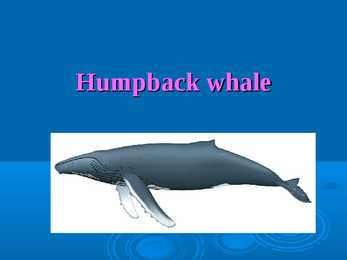
weighs up to 907 kg. Distribution and migration Is found in all the world's oceans. Most populations of humpback whales follow a regular migration route. They are summering in temperate and polar waters for feeding. They are wintering in tropical waters for mating and calving. Status Because their feeding, mating, and calving grounds are close to shore and because they are slow swimmers, the humpback whales were an easy target for early whalers. The International Whaling Commission (IWC) gave them worldwide protection status in 1966, but there were large illegal kills by the Soviets until the 1970's. It is believed they number about 30,000- 40,000 at present, or about 30-35% of the original population. Thank you for listening !
km. Highest peak is Wolf Volcano reaching 1707m. The present islands are all younger than 4 million years and were formed separately from other land masses as a result of volcanic eruptions. The Galapagos were discovered in 1535 by Fray Toms de Berlanga, the Bishop of Panama. He was sailing from Panama to Peru when he accidentally discovered the islands. Islands became a favorite hideout for Pirates and the favorite location for whale hunters. After whales were locally cleared the whalers went there for tortoises, an estimated 200 000 or more adults had been removed. The island of Floreana was populated with a group of convicts' in October 1832. Charls Darwin visited the island in 1835, he spent there 5 weeks. Nowadays five of the islands are populated with about 40 000 inhabitants. The name Island of Galapagos means island of tortoises. Every animal or plant had to cross about 1000 km of open ocean to arrive on Galapagos
people." During roughly 4000 years of human history in the Arctic, the appearance of new people has brought continual cultural change. The ancestors of the present-day Inuit, who are culturally related to Inuppiat (northern Alaska), Katladlit (Greenland) and Yuit (Siberia and western Alaska), arrived about 1050 AD. As early as the 11th century the NORSE exerted an undetermined influence on the Inuit. The subsequent arrival of explorers, whalers, traders, missionaries, scientists and others began irreversible cultural changes. The Inuit themselves participated actively in these developments as guides, traders and models of survival. Despite adjustments made by the Inuit over the past 3 centuries and the loss of some traditional features, Inuit culture persists - often with a greater reflective awareness. Inuit maintain a cultural identity through language, family and cultural laws, attitudes and behaviour, and through their acclaimed
 annaabi.ee