vertical reactions of the two walkways are carried by the two robust towers. The bascule pivots and operating machinery are housed in the base of each tower. The bridge's present colour dates from 1977 when it was painted red, white and blue for the Queen's Silver Jubilee. Originally it was painted a chocolate brown colour. The Tower Bridge in London remains one of the more popular tourist attractions in the city. In 1982, the upper walkway of the Tower Bridge London was opened to the public as an exhibition. The walkway was paved, the enclosed area lined with pictures and information about the Tower Bridge History. Views from atop the Tower Bridge London are incredible, and the windows have even been designed to allow tourists to take pictures from behind the glass without interference .
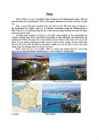
Nice Nice or Nica is a city in southern France located on the Mediterranean coast. With its natural beauty and sandy beaches, Nice, is the perfect destination for those who like sun and sea. Nice, is one of the most beautiful cities you will ever see. The main place of interest is the promenade des Anglais, which is a celebrated promenade along the Mediterranean at Nice, France. It is a walkway along the sea, where you can enjoy amazing view and see many luxurious private ships. Another place worthy of visiting is the small street parallel to the promenade des Anglais; leading from Nice's downtown, beginning at Place Massena, and shadowing the promenade towards the airport for a short distance about 4 blocks. This area of the city is off limits to cars, and by eliminating traffic creates a more serene setting. On this small strip
London - The City and Beyond The statue of a bronze dragon on Fleet Street is the entrance to the City of London. This is where the Romans founded Londinium almost two thousand years ago. The City covers about 2,6 square km (1 square mile) and is often called the Square Mile. Today, the City of London is one of the world's most important business and financial centres, with over 500 banks. Over 400 000 people work within the Square Mile during weekdays and it is a crowded and noisy place. The Barbican Centre is a very big complex of buildings, towers, garages and walkways. It was built in the 70s and most Londoners don't like the way it looks. It is the largest performing arts centre in Europe and home to two symphony orchestras, and art gallery and the amazing Museum of London. Fleet Street once was a road between the City and Westminster. Then it became the centre of publishing and newspaper business for centuries. The Dail...
· Newts · Black Swans The Sackler Crossing · Opened in May 2006 · Created by John Pawson · Made of stone and bronze · Named after the family name of the honoured scientists of Kew Sculptures · Made by architect Henry Moore · 28 sculptures · "Sculpture is an art of the open air" · Two-dimensional works: possible to see two things, depends where to look at Activities · Treetop walkway (height 18m, lenght 200m)- flexes, sways in the wind. · Short Courses and Study Days · Thinking Walks · Summer talks (about Indian landscape) · Summer Swing concerts Kew's work around the world Kew deals with the conservation of plants around the world: · In different areas of Africa: Cameroon (research in rainforests), Madagascar (Orchids) and South Africa · In Brazil · In Asia · In United Kingdom and Gibraltar Conclusion What I found out:
vegetable market in the central square. 2. For what is it also famous for?- It's also famous for its street entertainers (singers, dancers etc.) 3. What's the name of the famous theatre in there?- The Royal Opera house. Tower Bridge 1. Who opened the Tower Bridge?- The Prince of Wales and his wife, The Princess of Wales opened the Tower Bridge. 2. What river does the Tower Bridge cross?- It crosses the River Thames. 3. What's there between the towers?- There's a open air walkway between the towers. St Paul's Cathedral 1. Where does it locate?- It's at the top of Ludgate Hill, the highest point in the City of London. 2. When was it built?- It was built between 1675 and 1710. 3. Who was the famous architect who built it?- Britain's most famous architect Sir Christopher Wren. Buckingham Palace 1. How many rooms are there?- There are 775 rooms in there. 2. Who bought the Buckingham House for his wife?- George III bought Buckingham House for his wife. 3
The express area is located near Stansted also offers a range of the short stay car park while a Hotel Accommodation including free service is within the mid the Hilton, Premier Inn and stay. Radisson Blu hotels, the latter of wich is within two minutes of the Terminal building as an undercover walkway. Some Pictures Information & Pictures http:// en.wikipedia.org/wiki/London_Stansted_Airport https://www.google.ee/search?q=london+stanst ed+airport&biw=1366&bih=608&source=lnms&tbm= isch&sa=X&ei=A2QgVMT2Kcr8ywORx4GYCA&ved=0CAY Q_AUoAQ#tbm=isch&q=Stansted+airport&imgdii =_
Next to the center aisle, I recognized Edward Cullen by his unusual hair, sitting next to that single open seat. As I walked down the aisle to introduce myself to the teacher and get my slip signed, I was watching him surreptitiously. Just as I passed, he suddenly went rigid in his seat. He stared at me again, meeting my eyes with the strangest expression on his face -- it was hostile, furious. I looked away quickly, shocked, going red again. I stumbled over a book in the walkway and had to catch myself on the edge of a table. The girl sitting there giggled. I'd noticed that his eyes were black -- coal black. Mr. Banner signed my slip and handed me a book with no nonsense about introductions. I could tell we were going to get along. Of course, he had no choice but to send me to the one open seat in the middle of the room. I kept my eyes down as I went to sit by him, bewildered by the antagonistic stare he'd given me.
setback, all these are reversals of polarity that punctuate a story and give a sense of dynamic movement. T h e moments of reversal can be thrilling and memorable, like the scene of Norma Roe standing up in the factory to organize the workers. A R I S T O T L E ' S C O N C E P T OF R E V E R S A L Aristotle in his Poetics describes the essential dramatic device of the reversal. H e calls it peripateia, which refers to the "Peripatos" or covered walkway of Aristotle's Lyceum where he used to walk and talk with his students, developing ideas as they strolled back and forth. Perhaps he used the structure to demonstrate his logic, building up an argument forcefully as they traversed the colonnade in one direction, then demol ishing it just as thoroughly on the reverse trip. Aristotle says the sudden reversal of a situation for the protagonist can produce the desirable emotions of pity and terror in the audience; pity for someone
 annaabi.ee