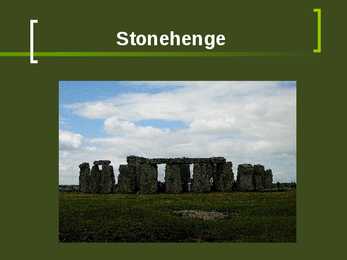
Three periods: Period I (c. 2950-2900 BC) - circular enclosure (56 Aubrey holes and 4 Station Stones inside it), outlined by two banks, ditch with an entrance to the northeast, heel stone, Period II (c. 2900-2400 BC) - unclear, (bluestones were brought in, post-holes were used to create a structure) Period III (c. 2550-1600 BC) - 1 circle of sarsen-stones and in it 2 circles of bluestones, (Altar Stone was placed), horseshoe-shaped setting of 5 sarsen trilithons (opening pointing to the northeast side) Stonehenge tour No Dogs Audio tour Admission prices: Adult £6.50 Concession £5.20 Child £3.30 Family £16.30
very much a domain of the dead. " Etymology Christopher Chippindale's Stonehenge Complete gives the derivation of the name Stonehenge as coming from the Old English words "stn" meaning "stone", and either "hencg" meaning "hinge" (because the stone lintels hinge on the upright stones) or "hen(c)en" meaning "hang" or "gallows" or "instrument of torture". Medieval gallows consisted of two uprights with a lintel joining them, resembling Stonehenge's trilithons, rather than looking like the inverted L-shape more familiar today. The "henge" portion has given its name to a class of monuments known as henges. Archaeologists define henges as earthworks consisting of a circular banked enclosure with an internal ditch. As often happens in archaeological terminology, this is a holdover from antiquarian usage, and Stonehenge is not truly a henge site as its bank is inside its ditch. Despite being
 annaabi.ee