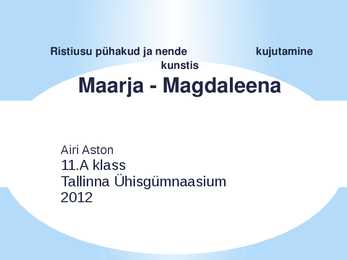
Firenze Muutke teksti laade Teine tase * El Greco "Maarja Kolmas tase Magdaleeena Neljas tase kahetsemas" Viies tase "Mary Magdalen in Penitence" 1578 1580 Worcesteri Kunstimuuseum , Muutke teksti laade *El Greco "Maarja Teine tase Kolmas tase Magdaleeena Neljas tase kahetsemas"
The Bible translation became the basic text that regulated the written Estonian language for more than a century. Despite its enormous impact on the development of the Estonian language, individualistic Pietism found a direct response primarily among the German-speaking clergy and nobility. The Estonian peasantry appears to have welcomed the movement of the Moravian Brethren which had started in Herrnhut in Saxony. In contrast to the Pietism, emphasizing penitence in the spirit of the Old Testament, the christocratic theological approach of the Moravians made them an optimistic and popular movement. This began to spread widely among Estonian 5|Page peasants in the 1730s, when the founder of the movement, Count Nikolaus Ludwig Zinzendorf, visited Estonia. As in its ministries elsewhere, the Estonian Moravian organization was based on Zinzendorf's
house arrest at his villa outside Florence. It was at this time that he wrote perhaps his finest book, th Dialogues Concerning Two New Sciences, a study of motion and inertia. His eldest daughter, Sister Marie Celeste (16001634), whom he had sent to a convent [ nunnaklooster ]against her wishes twentythree years earlier, stayed with him to the end. Every day she said the seven Psalms of penitence ordered by the Holy Office as part of his sentence. Galileo continued to gaze at the stars through his telescope until 1637, when his sight finally failed him. "This universe that I have extended one thousand times," he wrote, "has now shrunk to the narrow confines of my own body." The trial and condemnation of Galileo marked the climax of the first wave of the Scientific Revolution
 annaabi.ee