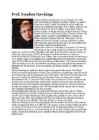
there being no one working in that area in Oxford at the time. His supervisor was Denis Sciama, although he had hoped to get Fred Hoyle who was working in Cambridge. After gaining his Ph.D. he became first a Research Fellow and later on a Professorial Fellow at Gonville and Caius College. After leaving the Institute of Astronomy in 1973, Stephen came to the Department of Applied Mathematics and Theoretical Physics and since 1979, has held the post of Lucasian Professor of Mathematics. The chair was founded in 1663 with money left in the will of the Reverend Henry Lucas who had been the Member of Parliament for the University. It was first held by Isaac Barrow and then in 1669 by Isaac Newton. Stephen Hawking has worked on the basic laws which govern the universe. With Roger Penrose he showed that Einstein's General Theory of Relativity implied space and time would have a beginning in the Big Bang and an end in black holes
For the first three years of his life he was sent out to a wet nurse and then lived with his grandmother. During this time his mother remarried, an act that did much to alienate Newton from his mother. As a child, Newton was never shown much love or affection. This may explain why he was always so isolated, detached and unemotional. Between 1660 and 1690, Newton devoted himself to an academic life at Cambridge. As the Lucasian Chair of Mathematics he was expected to lecture on a weekly basis, lectures which he frequently delivered to empty classrooms. He embraced a number of academic interests but the ones which interested him most were alchemy, theology, optics and mathematics. No field of study took precedence over another and he so he devoted as much of his energy and intellect to alchemy as he did to theology and mathematics.
 annaabi.ee