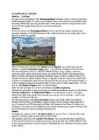
The London Eye is a giant Ferris wheel situated on the banks of the River Thames, in London, England. The entire structure is 135 metres (443 ft) tall and the wheel has a diameter of 120 metres It is the tallest Ferris wheel in Europe, and the most popular paid tourist attraction in the United Kingdom The London Eye is located at the western end of Jubilee Gardens, on the South Bank of the River Thames in the London Borough of Lambeth, between Westminster Bridge and Hungerford Bridge. Commonly known as the London Eye, or Millennium Wheel, formerly the Merlin Entertainments London Eye and before that, the British Airways London Eye. Since 20 January 2011, it has been officially known as the EDF Energy London Eye following a three- year sponsorship deal. The London Eye was formally opened by the then Prime Minister, Tony Blair, on 31 December 1999, although it was not opened to the public until 9 March 2000 because of technical problems.
and 1999. The London Eye has become the most popular paid tourist attraction in the United Kingdom, visited by over three million people in one year. When it was erected it was the tallest Ferris wheel in the world, until it was surpassed by the Star of Nanchang 160 m in May 2006, and then the Singapore Flyer 165 m on 11 February 2008. The London Eye is located at the western end of Jubilee Gardens, on the South Bank of the River Thames in London, United Kingdom, between Westminster Bridge and Hungerford Bridge. The site is adjacent to that of the former Dome of Discovery, which was built for the Festival of Britain in 1951. It was designed by architects David Marks, Julia Barfield, Malcolm Cook, Mark Sparrowhawk, Steven Chilton and Nic Bailey, the wheel carries 32 sealed and air-conditioned passenger capsules attached to its external circumference, each capsule representing one of the London Boroughs. In each capsule can be approximately 24 people, who are free to walk
We will walk down the Mall and past St. James's Palace and make some photos of the guards. Then we will go across Green Park to Piccadilly, where we can do some shopping. Afterwards we will walk east towards Piccadilly Circus. A quick stroll down Regent Street will bring us out onto Pall Mall, from where we can go on east towards Trafalgar Square. This is a home to one of London's most famous landmarks Nelson's Column. Then,before heading east across Hungerford Bridge to Waterloo, we'll go to the National Gallery. The National Gallery is London's premier art gallery, with over 2,000 works. Some of the artists on display include Botticelli, Cézanne, Constable, Monet, Rembrandt, Renoir, Titian, Turner and Van Gogh. We will end our day at a British Museum. The British Museum owns over six million exhibits from ancient Egypt, Greece, Italy, Africa and the Orient. It has major works by the Romans, Greeks and Persians
Star of Nanchang (160 m) in May 2006, and then the Singapore River (165 m) on 11 February 2008. However, it is still described by its operators as "the world's tallest cantilevered observation wheel" (as the entire structure is supported by an A-Frame on one side only). The London Eye is located at the western end of Jubilee Gardens on the South Bank of the River Thames in London, England between Westminister Bridge and Hungerford Bridge The site is adjacent to that of the former Dome of Discovery which was built for the Festifal of Britain in 1951. The Natsional symbols: The Flag of England is the Georges Cross . The red cross appeared as an emblem of England during the Middle Ages and the Crusades and is one of the earliest known emblems representing England. It achieved status as the national flag of England during the sixteenth century
 annaabi.ee