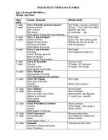
..? Yes, I did / No, I didn't Alan's summer play ball / the violin My summer go swimming / ...ing Polite English. Saying hello and introducing 3. nädal Unit 2. A trip to England Past Simple 4. nädal Outdoor activities by bus / car / train / plane, on foot English Country School Ordinals (the first, the second, ...) The Tower of London Posessive pronouns Polite English. Excuse me... 5. nädal Unit 3. A trip to Estonia Past Simple Travelling The comparison of adjectives Estonia. Writing a postcard Means of transport Polite English. Polite answers 6. nädal Unit 4. At the seaside Question words 7
the police, the public, the army, the management, the government The government has raised the teachers’ salaries. • to turn an adjective into a noun to refer to a group of people in general: the poor, the rich, the young, the old, the unemployed, the homeless, the disabled, the British, the Spanish, the Dutch The rich can never understand the poor. • before superlatives and ordinals: the best, the most beautiful, the nicest the second, the fourth, the twenty-first My birthday is on the fourth of July. • when referring to a particular type of something in general: The giraffe is the tallest of all animals. (the giraffe refers to the species) When was the telephone invented? (the telephone as a certain type of device) 5
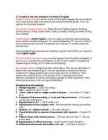
used. · Sometimes US Eng uses adjecitves instead of adverbs. · The comparative adjective ,,different" is usually followed by a preposition form in EngEng. In Us Eng it is more frquently followed by the word ,,than". · One particular ending is more productive in UsEng than in EngEng wise. · The adverbs ,,yet" ,,just" ,,already" and ,,still" are usually used with present perfect tenses. They are not possible in past simple in EngEng, but are so in UsEng. · The ordinals (firstly, secondly etc) are used in both varieties in numbering or listing. The difference is ,,first of all" when introducing next idea. Eng Eng uses ,,Secondly", UsEng uses ,,second of all", ,,third of all". · The adverb ,,presently means soon in both varieties. · Time adverbs ,,anymore" is used in both varieties in negative context. · There are some prepositions which differ in form in the two varieties. (EngEng ,,out of", ,,around"; USEng ,,out", ,,round"
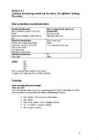
..................... 5 Check these figures again! 5 Would you mind ........................... 6 How does this damn computer work? 6 Could you tell .............................. 7 What's the phone code for Greece? 7 Do you happen .............................. 8 You'll have to work overtime this evening. 8 Do you think I could ask ................ 16 MODULE 4 Numbers, dates Cardinals and ordinals 1 one the first 11 eleven the eleventh 2 two the second 12 twelve the twelfth 3 three the third 13 thirteen the thirteenth 4 four the fourth 14 fourteen the fourteenth 5 five the fifth 15 fifteen the fifteenth 6 six the sixth 16 sixteen the sixteenth 7 seven the seventh 17 seventeen the seventeenth
 annaabi.ee