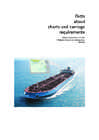
equipment and the different types of digital data available today. Acknowledgements: Kind assistance to ensure relevance and readability provided by: BIMCO, Primar Stavanger and IC-ENC. 4 Facts about chart carriage reguirements This compendium is also available at www.primar-stavanger.org and www.ic-enc.org, and will be kept up-to-date on a regular basis. The editing of the compendium was completed at 25 November 2004 Definitions A navigational electronic chart system is a general term for all electronic equipment that is capable of displaying a vessel’s position on a chart image on a screen. There are two classes of navigational electronic chart systems. The first is an Electronic Chart Display and Information System (ECDIS), which meets IMO/SOLAS chart carriage requirements. The second is an Electronic Chart System (ECS), which can be used to assist navigation,
danger, existing ships' routeing and reporting systems, vessel traffic services, and any areas where marine environmental protection considerations apply; 2) the main elements to ensure safety of life at sea, safety and efficiency of navigation, and protection of the marine environment during the intended voyage or passage; such elements should include, but not be limited to: Planning 2.1) safe speed, having regard to the proximity of navigational hazards along the intended route or track, the manoeuvring characteristics of the vessel and its draught in relation to the available water depth; 2.2) necessary speed alterations en route, e.g., where there may be limitations because of night passage, tidal restrictions, or allowance for the increase of draught due to squat and heel effect when turning; 2.3) minimum clearance required under the keel in critical areas with restricted water depth; Planning 2
animation, video, or interactivity content forms 3. Multimedia is usually recorded and played, displayed, or accessed by information content processing devices, such as computerized and electronic devices, but can also be part of a live performance 4. Multimedia may be broadly divided into linear and non-linear categories Linear active content progresses often without any navigational control for the viewer such as a cinema presentation Non-linear uses interactivity to control progress as with a video game or self-paced computer based training. 5. Multimedia presentations may be viewed by person on stage, projected, transmitted, played locally with a media player, streamed or broadcasted 6. Multimedia games and simulations may be used in a physical
9A flag Click to edit Master text styles Second level Third level Fourth level Fifth level · The British Union Jack flag notes Australia's ties to Great Britain · The Southern Cross is a major navigational constellation in the Southern Hemisphere · The large, white, seven-pointed Commonwealth Star is symbolic of the original states of Australia. Flag story the lower hoist-side quadrant known as the Commonwealth or Federation Star, representing the federation of the colonies of Australia in 1901; the star depicts one point for each of the six original states and one representing all of
time. But if it is a container ship, it can be secured alongside the berth for only hours and you may not be able to go ashore at all. Being an officer on board, you are required to work basically 12 hrs a day every day. You will have other work to do according to your rank. Such as the third officer, who will look after the lifesaving and firefighting equipment on board after his or her watch. The Second officer looks after the navigational equipment and acts as the doctor on board. And the Chief Officer will look after the shipboard maintenance and cargo operation on board. Should the ship enter or leave ports, you may be required to work twelve hours a day depending upon the type of ship’s contract. During the off duty time, you are free to do anything as you want, but you will seldom actually complete your rank duties during shifts, so you will actually have to over-work after those
moodustu ega saa ka midagi lahendada. Sfäärilise kolmnurga tekkeks peame kasutusele võtma koordinaatide h, ja täiendid 90 kraadini, mis meid ka rahuldab, kuna kõik koordinaadid on tekkinud kolmnurgas esindatud. Selle kolmnurga tippudeks on niisiis taevakeha, seniit ja poolus ning külgedeks 90° h, 90° ja 90° ; nurkadeks asimuut seniidi juures, tunninurk pooluse juures ja parallaktiline nurk q taevakeha juures. Polaarkolmnurk - navigational triangle Z 90° - A Q t Z 90° 90° - h PN A - La
o 4 off 540 kHz elements for the 2 axis log function o 1 off 270 kHz element for the auxiliary echosounder function 117 118 NAVTEX DEBEG 2902 This is paperless dual channel Navtex reciever. It monitors simulataneously 518 kHz and a selectable secondary frequency either the national 490 KHz or the4209,5 kHz for long range services. Navtex is an international, automated system for instantly distributing maritime navigational warnings, weather forecasts and warnings, search and rescue notices and similar information to ships. Echosounder DEBEG 4630 Features: • Single or dual channel operational covering 2 to 1000 meters of depth in 8 range steps manually or automatically • Single channel 50, 100 and 200 kHz • Dual channel 50/100, 100/100 or 50/200 kHz • Up to 24 hours automatically stored data • Stored data can be displayed graphically and digitally • Audible and visual alarm
 annaabi.ee