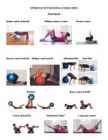
STRENGTH TRAINING EXERCISES Abdominals Seated crunch on the ball Oblique crossover crunch Reverse crunch Reverse crunch with ball Oblique crunch on ball Abdominal Pike Knee Pull Ball Pass Basic crunch on BOSU V-sit on the BOSU Abdominal "Bike" Long arm crunch Strength Training Exercises Back and core
A class is made up of 45 minutes of stretches, balances and toning exercises and is followed by 10 minutes of relaxation and meditation. Usually this class is started with Tai Chi warm up. Next it would be yoga pose sun salutions. After it would be done balances pose including the tree pose which is good for strength building. Then, hip stretches followed. The purpose of doing that is to unlock the stiffness in the lower body. After that, it is pilates meant for the abdominals and lower back muscles. Some stretching exercises and the final track is a relaxing small meditation. Doing meditation you could clear the mind. WHY it works? Controlled breathing, concentration and a carefully structured series of stretches, moves and poses - All these create a holistic workout that brings your body into a state of harmony and balance. If you want to try bodybalance, just do it! This training is perfect for those who have
The latter will be covered in later chapters. Drew Baye after more than six months of no direct abdominal exercises. It goes to show how diet is often a determining factor. (Photo: Mike Moran) Movement #1: The Myotatic Crunch I began my analysis by looking for common attributes in exercises that hadn't worked. The shared feature of all the dominant exercises, in particular the oor crunch, is that they used no more than half of the full range of motion (ROM) of the abdominals. If you were to imagine yourself sitting in a chair, the prescribed exercises all took you toward your knees (crunch, oor sit-up) or brought your knees toward your chest with a straight back (roman chair, reverse crunch). I decided to ignore that fetal range of motion altogether for eight weeks and focus on the stretched position achieved with full back extension. The result was the myotatic crunch, so named because it leverages the fully stretched position
 annaabi.ee